Matter Protocol Guide: The Unified Standard for Smart Homes
Ending Smart Home Fragmentation
Have you ever encountered these frustrating situations when building your smart home:
- The smart bulb you bought only works with Xiaomi's Mi Home, making it impossible to control via Siri on your iPhone?
- To get voice control through Siri, you are forced to pay double or triple the price for a product labeled with "Works with Apple HomeKit" certification?
- Smart devices from Xiaomi, Huawei, Aqara, and other brands operate in isolation, unable to coordinate or trigger automations together?
The Matter protocol was born to end this exact fragmentation in the smart home ecosystem — it aims to let all smart devices speak the same "universal language".
What is Matter?
Core Definition

Matter is an open-source, cross-platform communication standard for smart homes developed jointly by global technology giants.
Who is Pushing It
- Governing Body: CSA (Connectivity Standards Alliance)
- Core Promoters: Apple, Google, Amazon, Samsung, and other global tech industry leaders.
- Shared Goal: To tear down the walled gardens of proprietary ecosystems and establish a secure, reliable, and seamlessly connected smart home environment.
💡 Core Innovation: Matter is not a new hardware wireless technology (it is not meant to replace Wi-Fi or Bluetooth). Instead, it runs on top of existing connection technologies (Wi-Fi, Thread, Bluetooth LE) to establish a unified "translation rule" (Application Layer Protocol). This allows devices using different wireless methods to speak the same language seamlessly.
Simple Analogy
If you think of Wi-Fi or Thread as high-voltage electrical wires, then Matter is the universal plug and outlet standard. No matter who manufactured the appliance, it will plug in and work immediately.
Pain Points of the Walled Garden: The "Tower of Babel" in Smart Homes
Before Matter matured, the smart home market suffered from severe fragmentation. Here is a comparison of what Matter changes:
❌ The Old Way: Ecosystem Walled Gardens
- Fragmented Platforms: Apple HomeKit, Google Home, Amazon Alexa, and Samsung SmartThings operated in silos.
- Complex Selection: Users had to check compatibility labels meticulously before purchasing any device.
- No Inter-connectivity: A motion sensor from Brand A could rarely trigger a lightbulb from Brand B.
- Higher Hardware Costs: Manufacturers had to build and certify separate hardware versions for different platforms, passing the cost down to consumers.
- Gateway Clutter: Homes were cluttered with multiple hubs and bridges to translate different brands.
✅ The Matter Way: Unified Interoperability
- Out-of-the-Box Compatibility: A single standard connects all Matter-certified devices.
- Stress-Free Shopping: Look for the Matter Logo on the package, and buy without worrying about platform lock-in.
- Single Router Management: Multiple ecosystems can manage the home simultaneously without requiring individual brand hubs.
- Freedom of Choice: Consumers can mix and match devices based on price and features, rather than being locked into one brand.
How Does Matter Work?
Matter's speed and reliability are achieved through its forward-thinking three-layer architecture:
1. Underlying Transports
Matter is network-agnostic, running smoothly over three primary connection protocols:
- 📡 Wi-Fi: Best for high-bandwidth, mains-powered devices (e.g., smart displays, cameras, hubs). It offers high speeds but consumes significant power.
- 🔗 Thread: A low-power, self-healing mesh networking protocol designed specifically for smart home accessories (e.g., sensors, light switches, smart locks, bulbs).
- 🔵 Bluetooth LE: Used solely for the initial setup, scanning, and onboarding of new devices (pairing). It is not involved in day-to-day control data transmission.
2. Thread Mesh Topology vs. Star Topology (Wi-Fi)
Thread is the perfect companion for the Matter protocol, resolving the disconnection and battery-drain issues commonly associated with older wireless standards like Zigbee or Wi-Fi direct-connect.
To visually understand the topological differences:
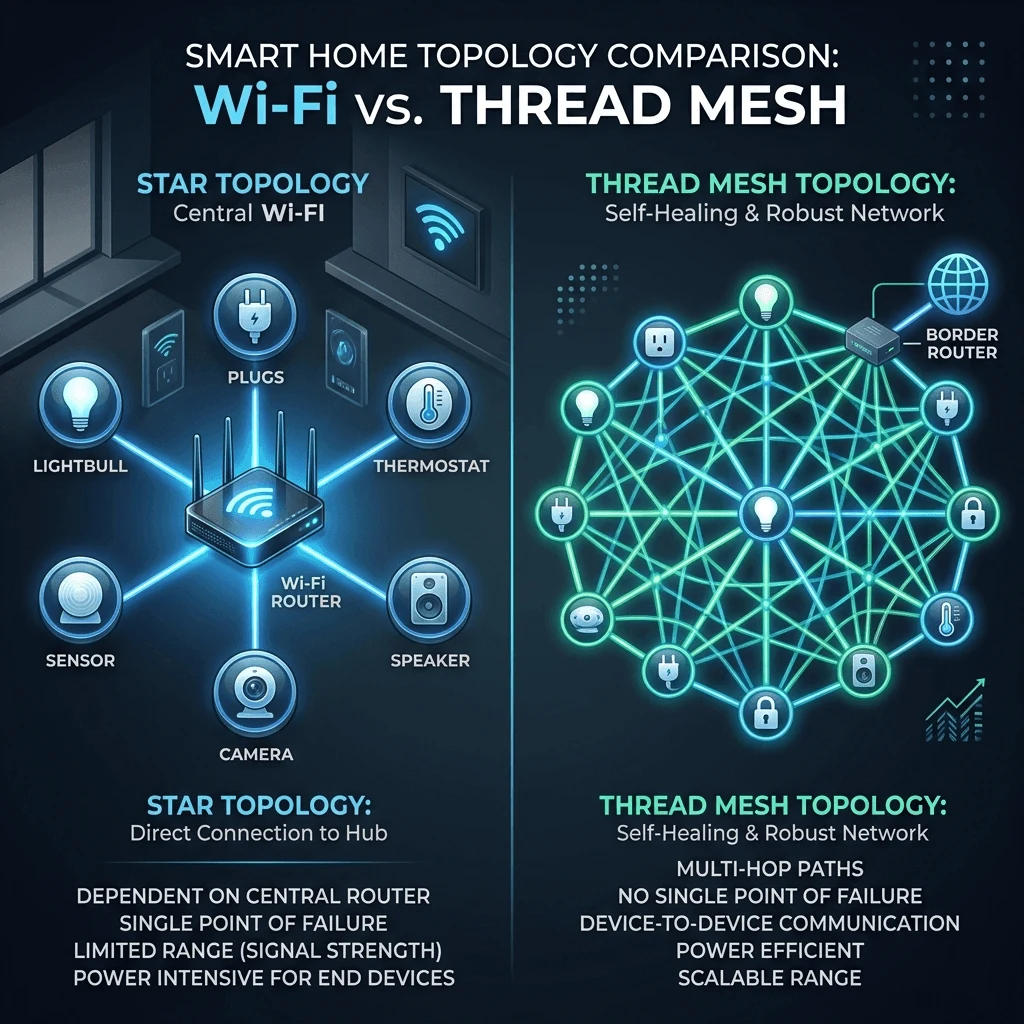
The Limitations of Star Topology (Wi-Fi)
- Single Point of Failure: Every device must connect directly to the central router.
- Router Overload: A standard home router often lags or crashes when managing dozens of smart home accessories.
- Signal Deadzones: Devices far away from the router suffer from weak signals and constant disconnections.
The Advantages of Mesh Topology (Thread)
- Self-Healing: Devices act as repeaters to pass signals along. If one device goes offline, data automatically routes through another path.
- Infinite Expansion: The network actually gets stronger and covers more area as you add more devices.
- Extreme Battery Efficiency: Sensors can run on coin-cell batteries for years without replacement.
3. Local Control (Privacy and Speed)
Traditionally, smart homes relied heavily on cloud relays:
Your Phone App ➔ Internet Cloud Server ➔ Brand Server ➔ Smart Device at Home
This created two critical pain points: if your internet went down, your house became dumb; and all your device logs were uploaded to third-party servers, posing privacy concerns.
Matter prioritizes local communication:
Your Phone App ➔ Local Matter Hub (Controller) ➔ Smart Device (via Local Network)
Advantages of Local Control:
- Offline Control: Even if your external fiber connection is cut, you can still control all devices via your local Wi-Fi or Thread network.
- Zero Latency: Commands travel at LAN speeds, triggering switches and scenes in milliseconds.
- Privacy Protection: All device interactions are processed locally inside your home, not uploaded to vendor clouds.
💡 What is a Matter Controller / Hub?
It acts as the local brain inside your home. Many devices you already own can become Matter controllers with simple firmware updates, such as:
- Apple HomePod / HomePod mini / Apple TV 4K
- Google Nest Hub / Nest Hub Max
- Amazon Echo smart speakers
- Other Matter-certified touchscreens or tablets
The 4 Killer Advantages of Matter
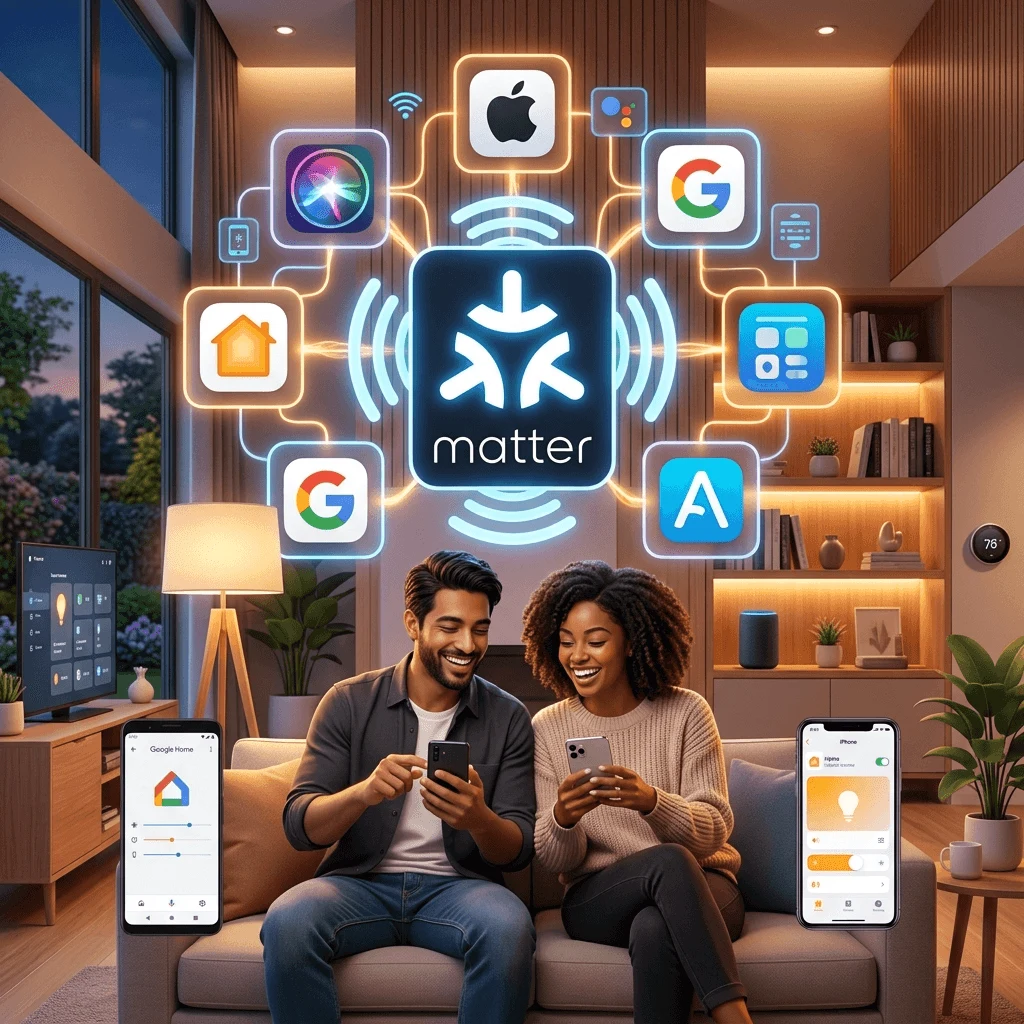
🌍 Multi-Platform Support (Cross-Ecosystem)
Under the Matter standard, cross-ecosystem control is effortless. You no longer have to choose between HomeKit or Google Home when buying a bulb. A single Matter lightbulb can connect to Apple Home, Google Home, and Alexa simultaneously.
👥 Multi-Admin Control
Multi-Admin allows a single device to be shared concurrently across different platforms:
- The father can use an iPhone to control lights via Apple Home.
- The mother can use an Android device to control the same lights via Google Home.
- Autonomies coexist locally without account sharing, keeping personal data private.
🏠 Local-First Stability
With Thread's self-healing capabilities and local routing, the system remains stable regardless of external internet outages.
📱 Easy Setup
Onboarding is standardized and simple:
- Open your smartphone's camera app.
- Scan the Matter QR Code printed on the device.
- The accessory securely pairs and joins your home network in seconds.
Who is Supporting Matter?
Today, Matter has become the undisputed benchmark and future direction of the global smart home industry.
🏢 Key Alliance Members
- Ecosystem Platforms: Apple, Google, Amazon, Samsung SmartThings
- Chipsets & Wireless Silicon: Silicon Labs, Nordic Semiconductor, Qualcomm, NXP
💡 Featured Device Manufacturer Ecosystem
| Category | Leading Brands & Manufacturers |
|---|---|
| Architectural Lighting | Philips Hue, IKEA, Nanoleaf, Eve |
| Security & HVAC | Yale, Ecobee, Google Nest, Aqara |
| Smart Plugs & Electrical | Eve Energy, Meross, Wemo |
| Sensors & Environment | Eve Sensor, Aqara Sensor, Tuya Smart |
Communication Protocols Compared
Here is how Matter stands up to other popular smart home standards:
1. Matter vs. Zigbee
| Comparison | Matter | Zigbee |
|---|---|---|
| Interoperability | ⭐⭐⭐⭐⭐ Universal (cross-brand) | ⭐⭐⭐ Fragmented (locks to same brand bridge) |
| Onboarding | Scan QR code | Complex bridge pairing |
| Future Outlook | Global industry standard | Fading, replaced by Thread |
| Cost Efficiency | Lower chip costs once scaled | High implementation costs |
💡 Selection Advice: Zigbee is mature, but suffers from fragmentation. If you are building a new smart home system, prioritize Matter (Thread/Wi-Fi) to ensure future compatibility.
2. Matter vs. KNX (Wired Industrial Standard)
| Comparison | Matter Protocol (Wireless/Hybrid) | KNX Bus Protocol (Wired) |
|---|---|---|
| Level | Consumer-grade (flexible, DIY) | Industrial-grade (ultra-stable, building-lifetime) |
| Installation | Plug & play, no wall tearing | Professional wiring and pre-construction planning |
| Cost | 💰 Budget-friendly | 💰💰💰 Expensive equipment and programming fees |
| Reliability | ⭐⭐⭐⭐ High | ⭐⭐⭐⭐⭐ Extremely High (No radio interference) |
| Scenarios | Residential homes, retrofits | Luxury villas, commercial buildings, hotels |
💡 Selection Advice: For most residential spaces, Matter offers the best flexibility and value. For premium estates with a high budget and requiring absolute physical wiring stability, KNX is the gold standard (you can also bridge them using a KNX-Matter gateway).
How to Get Started with Matter
1. Planning a New Home or Renovation
- Get a Matter Hub: Buy a high-quality controller like Apple HomePod mini or Nest Hub.
- Choose Thread Accessories: Prefer Thread switches, sensors, and bulbs over Wi-Fi versions for battery efficiency.
- Build Incrementally: Add smart devices modularly as your needs grow without worrying about future compatibility.
2. Upgrading an Existing Smart Home
- No Need to Discard Old Gear: Existing devices will continue working normally within their native platforms.
- Look for Firmware Updates: Major manufacturers (like Philips Hue and Aqara) have pushed Matter bridge updates to connect existing accessories seamlessly.
- Gradual Transition: Purchase Matter-compatible hardware whenever replacing broken devices or adding new rooms.
Frequently Asked Questions (FAQ)
Q: Is Matter secure? Will it expose my home network to hackers?
A: Matter offers superior security compared to traditional legacy smart home systems:
- Local Communication: Data stays within your local network without mandatory cloud transmission.
- End-to-End Encryption: Every device undergoes cryptographic validation before joining.
- Open-Source Auditing: Global developers and cybersecurity teams continually audit and patch vulnerabilities.
Q: Are there recurring subscription fees or licensing costs for Matter?
A: No. Matter is a royalty-free, open standard. Once you purchase a Matter-certified device, its local and cross-platform capabilities are completely free for the life of the product with no ongoing fees.
Q: Do I need a Thread Border Router?
A: If you use low-power Thread accessories (like door sensors or smart locks), yes. A Border Router (built into Apple TV 4K, HomePod, Nest Hub) bridges the Thread mesh network to your home Wi-Fi/Ethernet. If you only use Wi-Fi Matter devices, a standard router and local hub are sufficient.
Summary: Matter is the Future of Smart Homes
The arrival of Matter marks the end of walled gardens in smart home technology. It puts freedom of choice back where it belongs: in the hands of the homeowner.
Investing in Matter devices today ensures your home is built on a resilient, future-proof digital infrastructure that will evolve smoothly for years to come.
📚 Related Technical Articles
- 📖 KNX Wired Standard Guide: The Rock-Solid Bus System for Luxury Homes
- 📖 Loxone Austrian Smart Living Guide: Miniserver Local Automation
- 📖 Control4 Luxury Smart Home Integration & AV Systems
Last Updated: June 2026
Sources: Connectivity Standards Alliance (CSA) Official Specifications, Vendor Announcements.
Disclaimer: Product prices and compatibility are subject to firmware updates; please refer to vendor documentation for details.
 ✓
✓Dadao
Technical DirectorKNX System Certified Engineer16+ years of engineering experience in KNX / Control4 and luxury villa smart low-voltage infrastructure. Specializing in KNX, Control4, Apple HomeKit, and Matter ecosystems.